The 2026 edition of Engage was held at the KAA Gent football stadium, a spectacular venue that is well-suited to hosting events.

HCL and IA
By 2026, there will be no excuse for not discussing AI: any large (or small) tech company must have a clearly defined AI strategy and be prepared for change, as every month, every week, and indeed every day, we are seeing news and developments that effectively render what was agreed months ago obsolete.
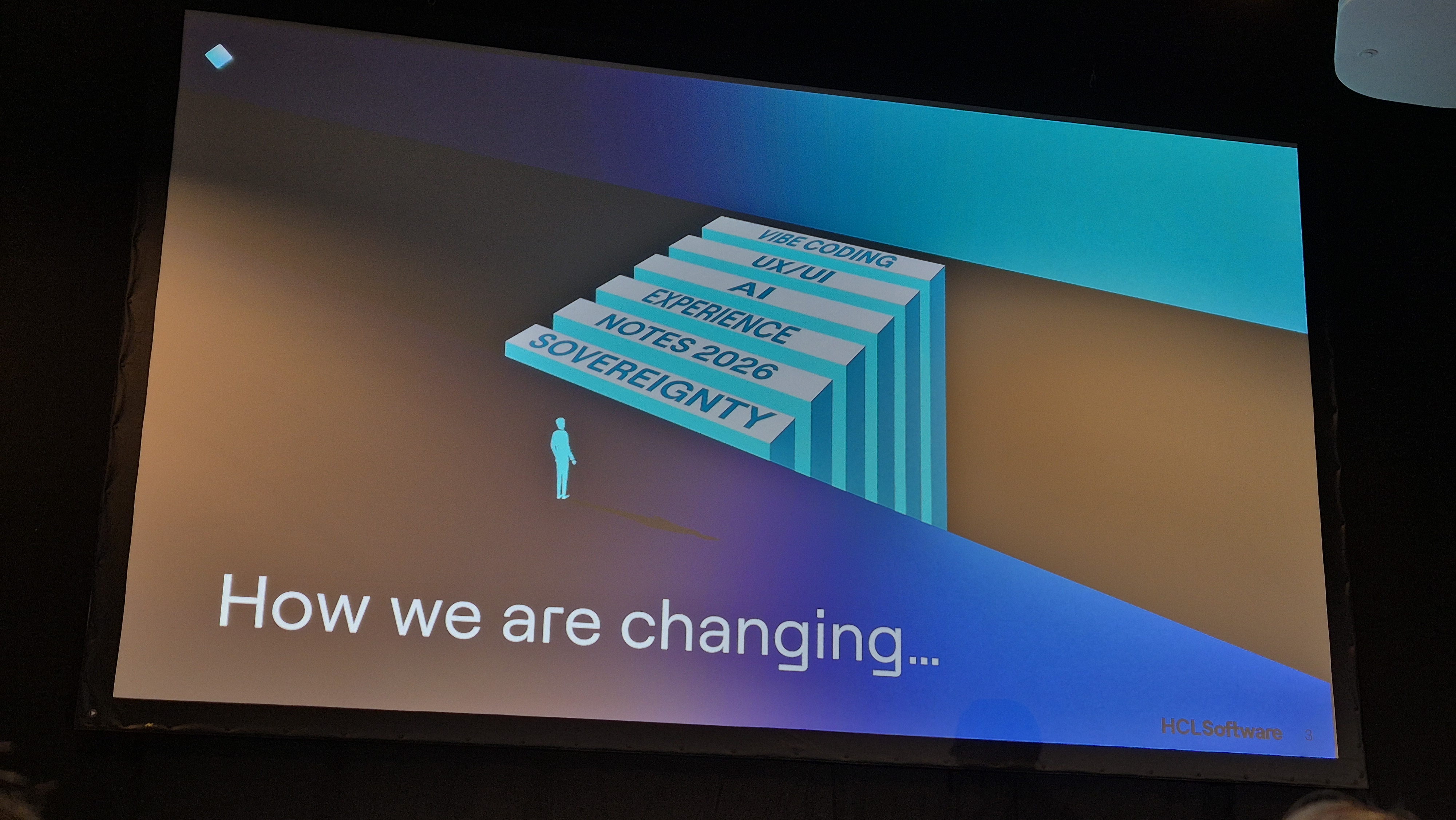
inside of this storm of events, HCL is moving quickly and, step by step with each new release, is making progress with its AI strategy. On Monday, we had the chance to try out HCL Leona at the workshop ‘World of Vibe Coding for Domino users including DRAPI’ to do Vibe coding for web applications. The following day, at the Keynote, HCL’s CTO, Jason Roy Gary, officially unveiled HCL Leona as a generator for traditional Domino applications (forms, views, etc.) using only natural language, without the need for HCL Designer, and without a single line of code.
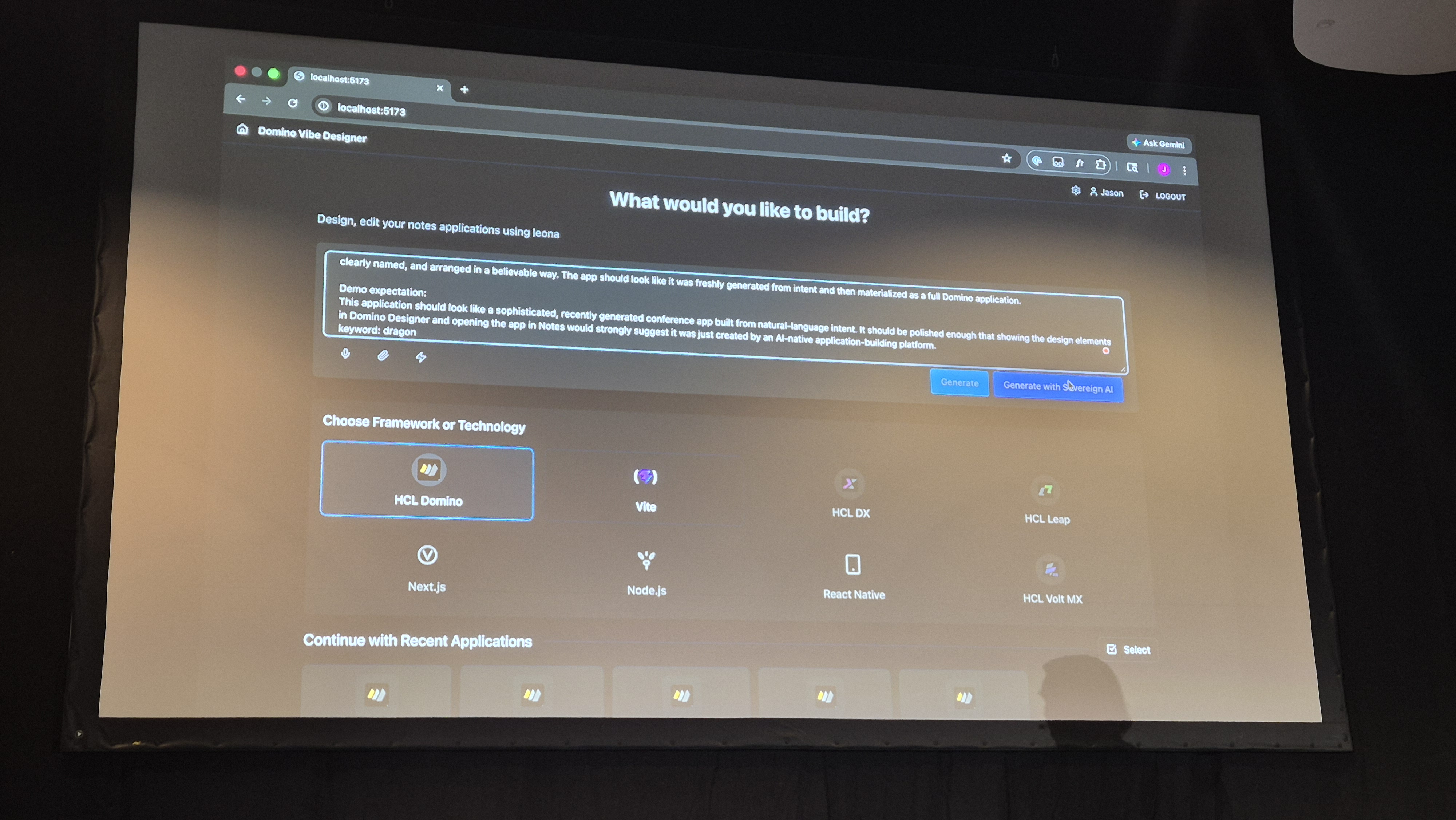
It won’t be available to the general public any time soon, but they’ve announced that a closed beta will be released shortly. It seems that HCL’s initial plans are to launch it as a paid service, but nothing has been said yet.
HCL, Domino Workspace and Data Sovereignty
The key to HCL’s major commitment to AI lies in data sovereignty. Today, with the new Domino 2026 release, it is possible to run LLMs and to use RAG entirely on-premises with our own data. No exposure to third parties.
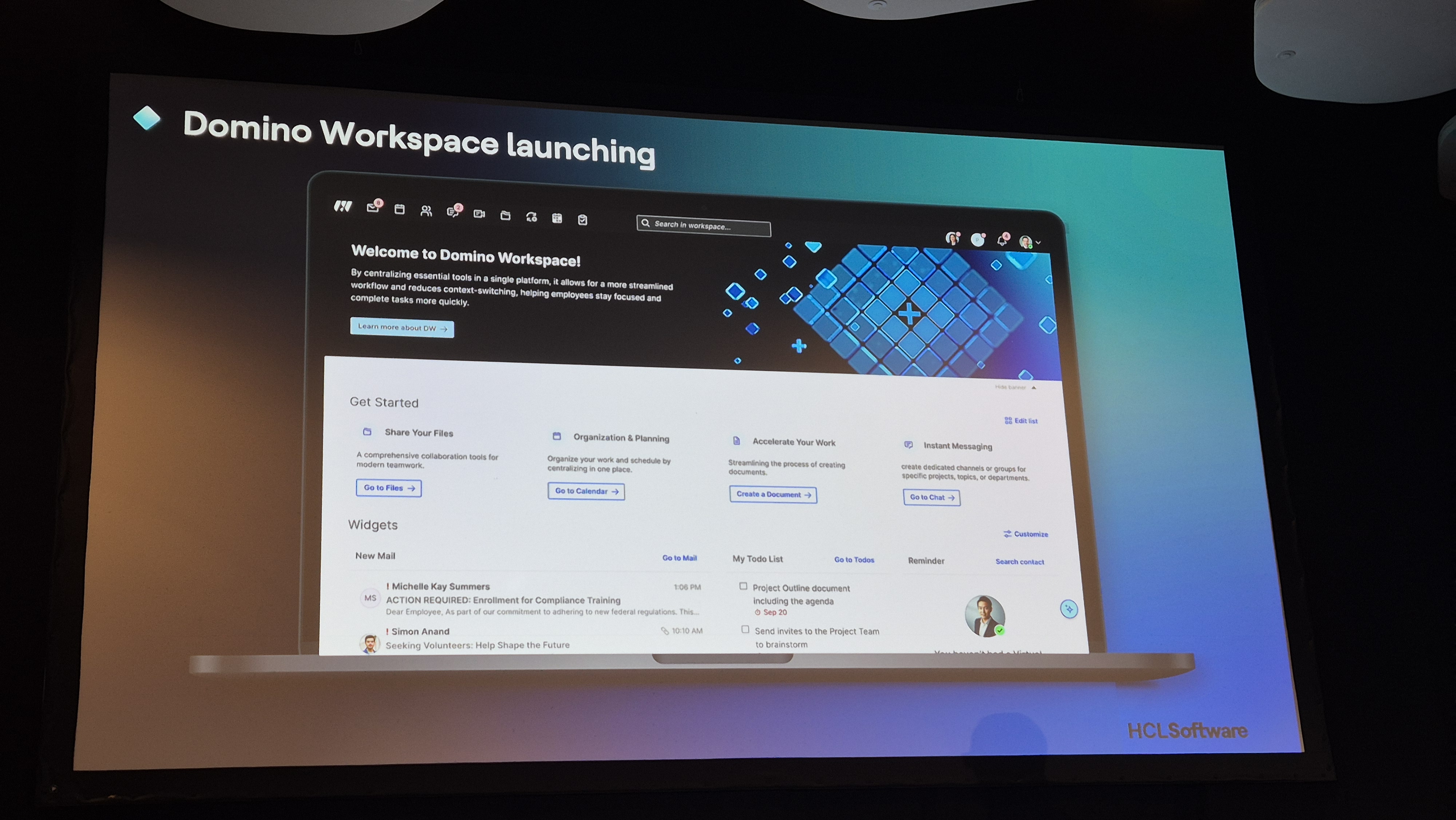
Furthermore, HCL has also unveiled the final version of what will be Domino Workspace. A collaboration suite that provides basic day-to-day functions, such as email, calendar, document editing, shared files, … without compromising data sovereignty. The initial presentation took place back in 2025 (it was initially called “Lotus Workspace”), but it seems that the final version will indeed be available this summer.
Domino+ Roadmap
As we do every year, we were able to see HCL’s plans for all the products in its catalogue.
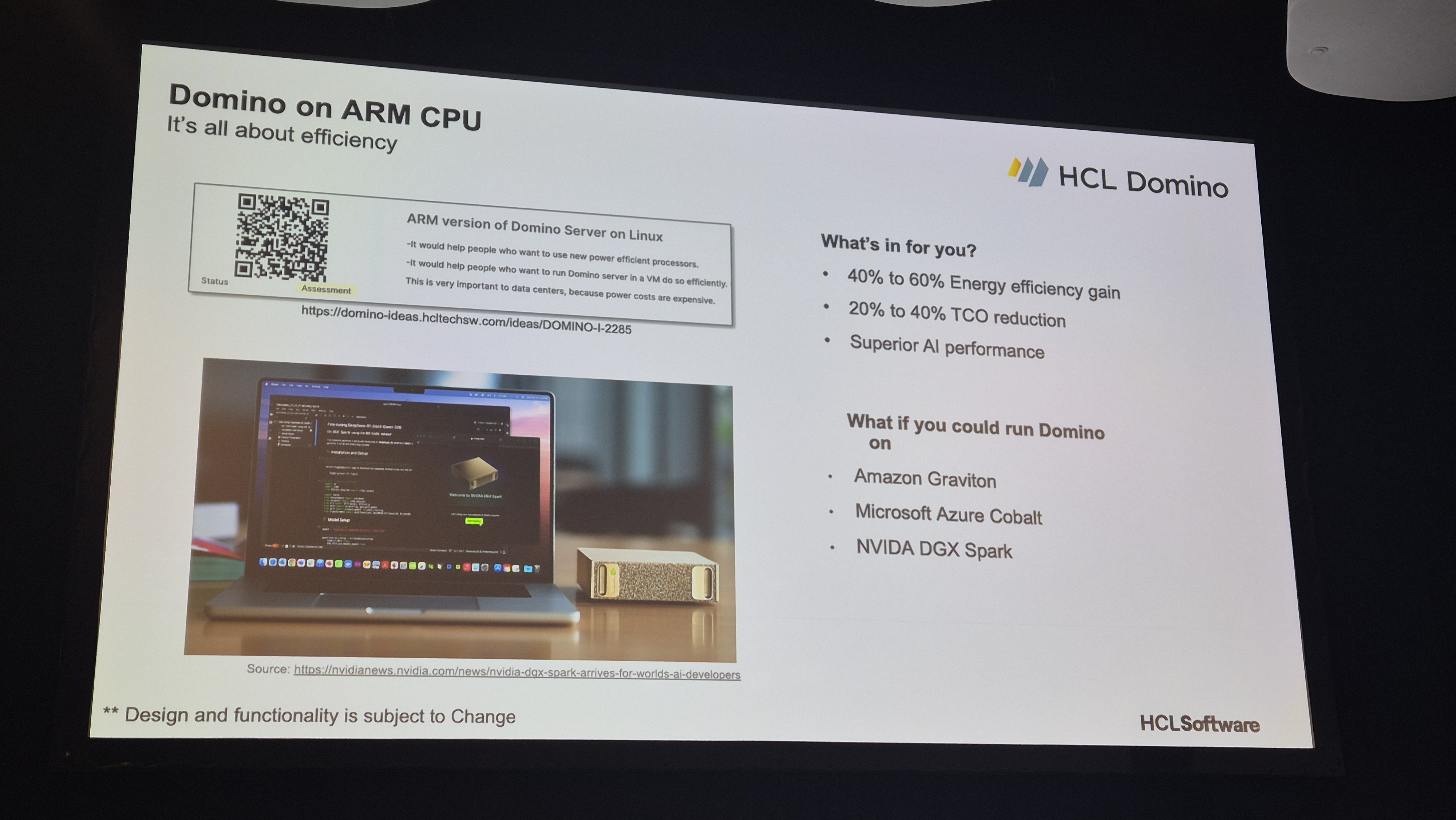
As for the Domino server, we can expect greater integration of AI as well as the adoption of current security standards, such as TLS 1.3, HTTP/2 and DMARC. Furthermore, in some sessions we were shown a Domino server running on a Raspberry Pi, which leads us to believe that support for ARM processors is on the horizon.
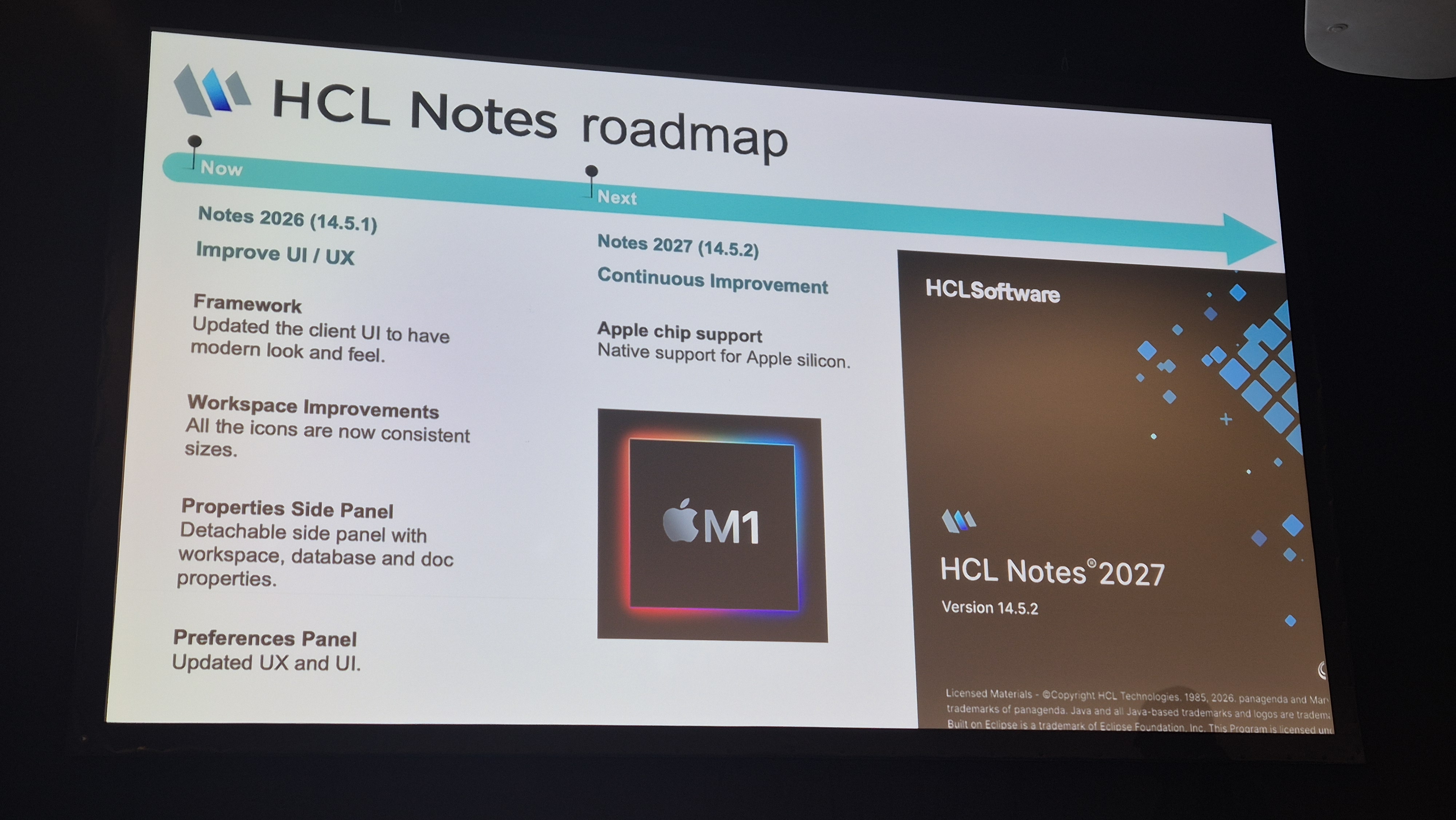
Similarly, the Notes client appears set to offer better integration with Apple Silicon, significantly improving performance on Macs.
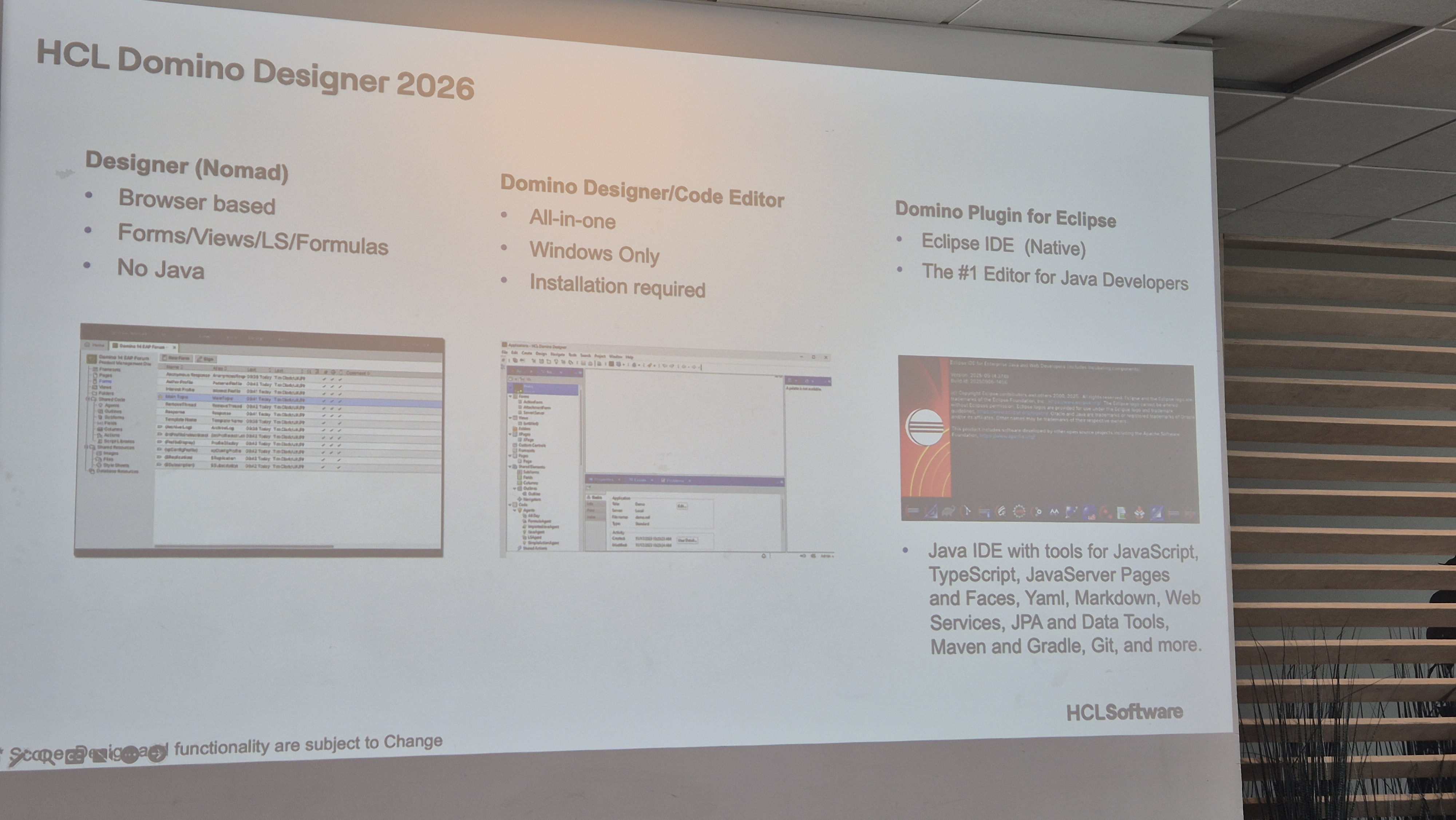
During the “Application Development Roadmap” session presented by Heiko Voigt, Thomas Hampel and Serdar Basegmez, a new option for Domino application development was demonstrated with the launch of an Eclipse plugin for Domino. This would give us direct access to our Domino server from within the Eclipse IDE for developing Java and XPage applications, without the need to use HCL Designer.
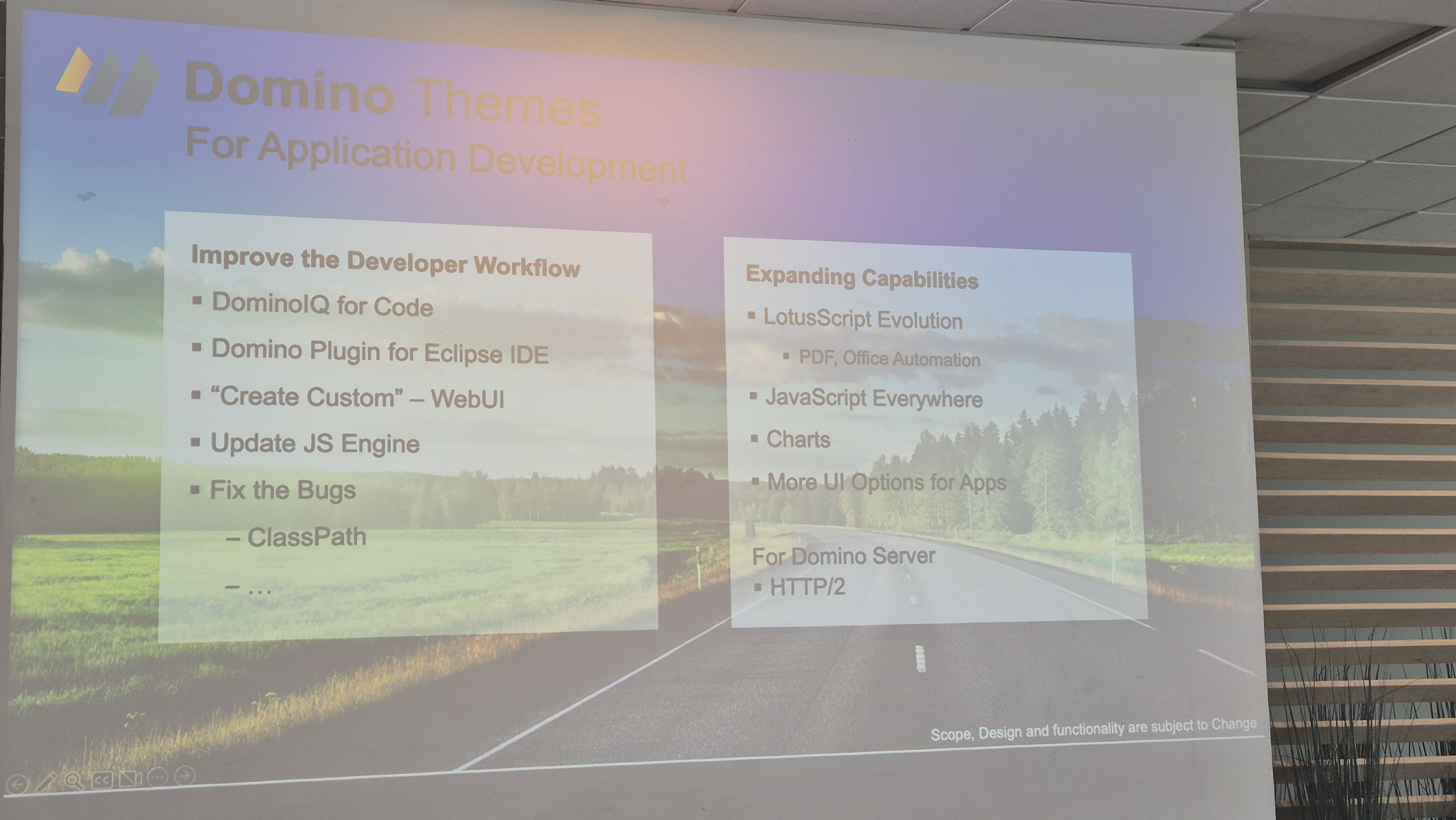
There was also discussion of potential improvements to development, such as the use of MCP in Designer, the ability to create statistical charts within the Notes client, and new features in LotusScript for data streaming, cryptography, and the automation of PDFs and Office documents.
I find it strange how little (or even no) attention a product like HCL Domino Leap has received. Three years ago, custom widgets were added, and since then we haven’t seen any major new features.
HCL Mosaic
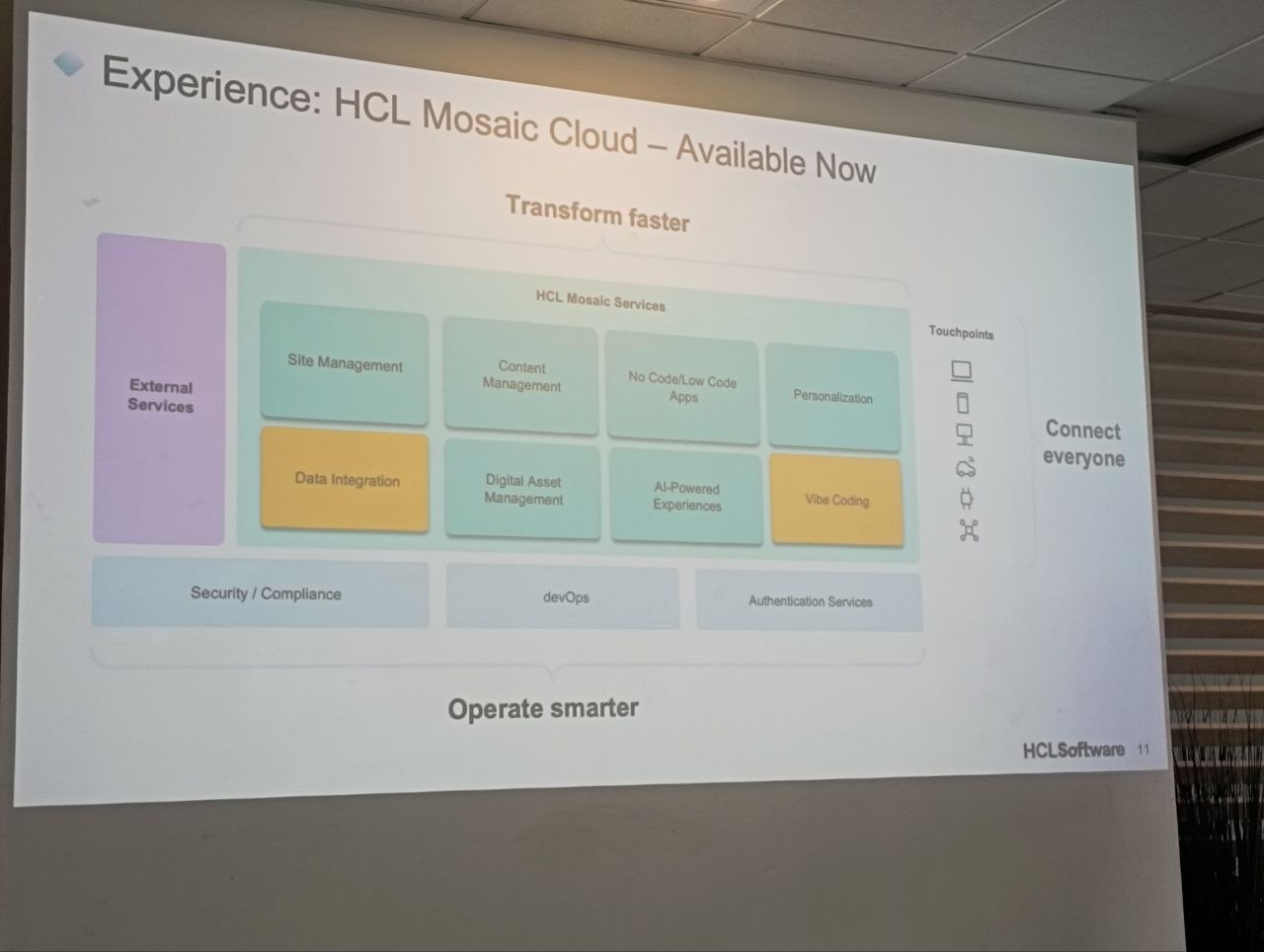
We were also introduced to HCL Mosaic, a cloud platform designed to host HCL’s products and offering the ability to use AI to generate natural language applications, available directly within the cloud itself.
New interactive Lotusscript class map
Meanwhile, OpenNTF has released an interactive version of the classic LotusScript class map, updated for Domino 14.5.1. If you develop in LotusScript, it’s well worth bookmarking. I’d like to take this opportunity to congratulate Grahan Acres and the whole OpenNTF team.
Interesting sessions
In the session ‘*In Olden Times…*’ by Carl Tyler, we were taken on a journey through the history of Lotus Notes … right back to version 1.0! He used a different virtual machine to emulate each of the operating systems required to run each version of Lotus. For someone like me, who entered the Domino world with version 8.5, it has been very rewarding to learn a little bit of history and see how version 1.0 already contained many of the features we use today, almost forty years later.
In the session ‘The Nifty 50 Meets Vibe Coding’, Jason Roy Gary spoke to us about an internal project aimed at creating a JSON schema equivalent to the current DXL, but more accessible for interacting with HCL Leona. The aim is to use HCL Leona to generate no fewer than fifty business templates (beyond blogs, wikis, etc.) ready for use from the NOtes client.
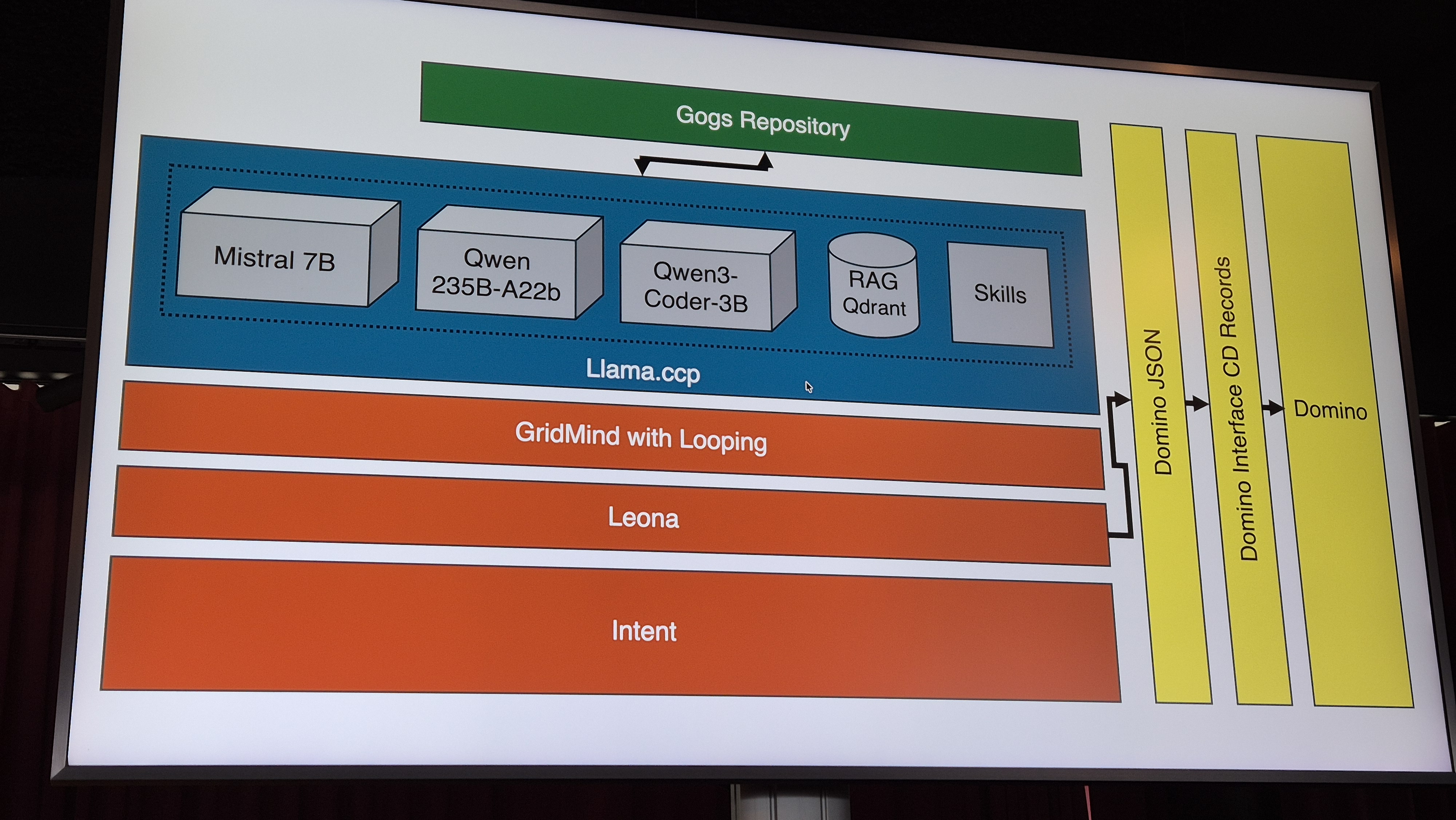
Mi presentation
You might find my presentation of interest if you’re an XPage developer. It’s titled “XPages without Dojo” and outlines a possible approach to developing in XPages by replacing the Dojo ecosystem with a more modern alternative. I’ll discuss this in more detail later, in a separate post dedicated to the topic.
IA
My colleague at Data101, Dominique Pérarnaud, has put together a session on the possibilities AI offers you as a Domino administrator, entitled ‘How to be a better HCL Domino Admin using AI’. The work he is doing is admirable, as is the adaptability he demonstrates in incorporating AI into his workflow. On his LinkedIn profile you can see this progression and some of his work over the last few months.
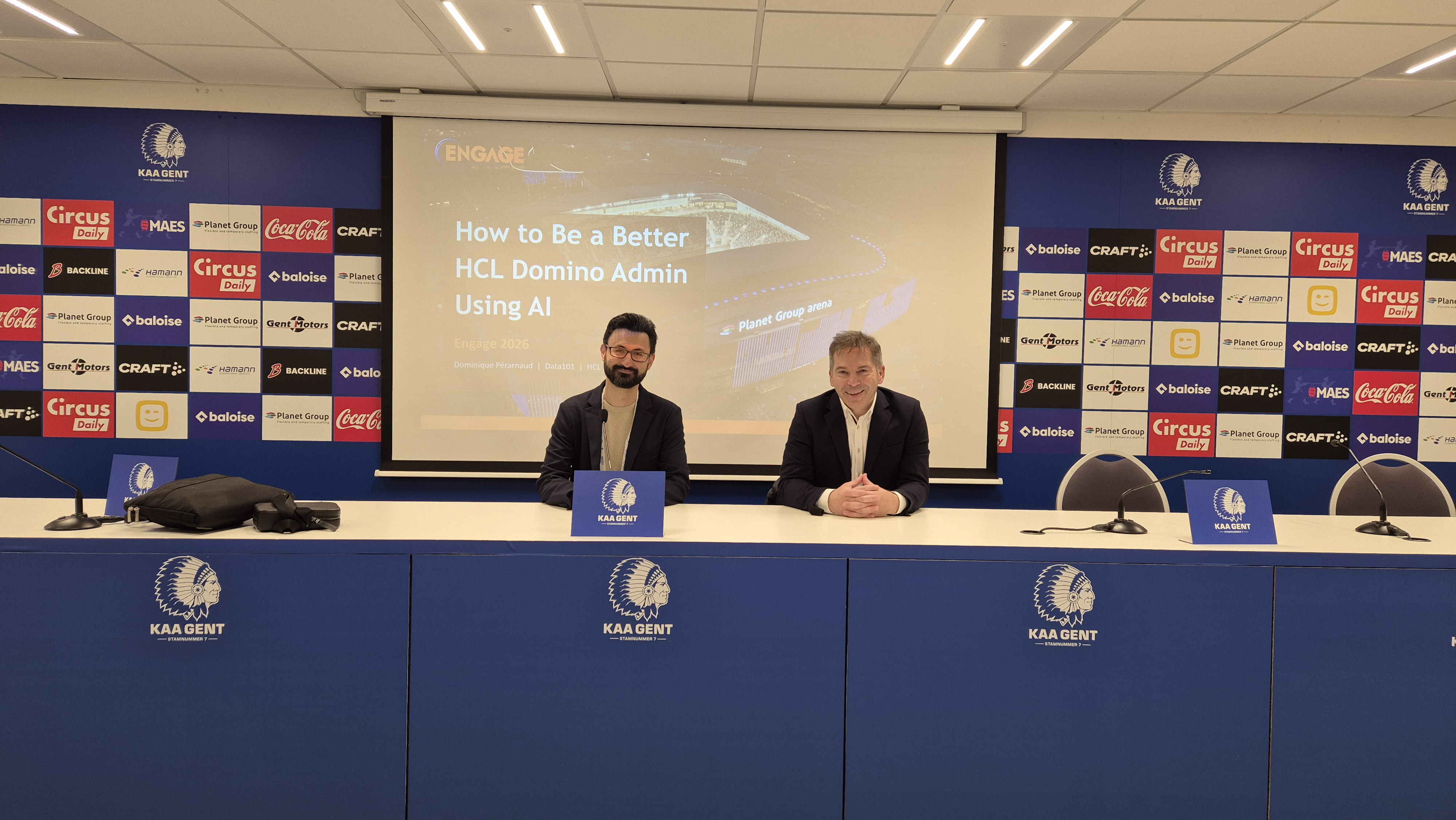
Looking back at the sessions, there were few dedicated to app development that weren’t, in one way or another, laced with AI. The paradigm shift is very real. Companies such as Anthropic, OpenAI and Google provide tools which, when used effectively, can boost our productivity to levels that were unimaginable just a few months ago.
It’s clear that HCL has got the message. We have this first step, which is Domino IQ, and we see this being expanded in Domino 2026. At Engage 2026, they announced HCL Leona as an application generator for the HCL ecosystem. All of this inside a philosophy of data sovereignty, which is particularly important in the current geopolitical context.
But we need more. Building applications from scratch using natural language is very good, and can be a very useful tool for prototyping or even for generating simple applications. But for the development of complex enterprise applications, within a well-defined architecture such as HCL Domino that is open to extensions, we need an AI-driven development methodology. We need HCL Leona to understand us, but we also need to understand how Leona can best help us and how we need to ‘explain’ our requirements to it and provide the necessary context to reach a satisfactory mutual agreement.
Engage, as always
Last year we saw a significant drop in attendance compared to the previous edition. This year, numbers have risen, and we’ve also seen some new, young faces. Quality standards remain as high as ever. The staff’s hospitality, the quality of the food, the venue, and even the official dinners and ambassador drinks – all set against the backdrop of the beautiful city of Ghent provided the perfect setting for this year’s Engage.
A lovely moment came at the end of the event when Tom Van Aken, one of the organisers, made an appearance, following the health issues that had prevented him from being at the forefront. I would like to wish him a speedy recovery and offer my congratulations to him, Kris and his family, whom we saw helping out with the organisation throughout.
Conclusion
The world sees Domino and Notes as robust but outdated tools. Many abandoned the platform back in the IBM days. Others are stuck, trying to migrate (some unsuccessfully) to other platforms. Now, HCL can capitalise on the paradigm shift offered by AI to once again become a leader in enterprise application management. Let’s work together to make Domino modern, integrable and efficient once more.
Let’s all work together to make Domino legendary.
Comments